Reset
We’re celebrating an anniversary. In this 2026 edition, Getxophoto turns twenty, so we want to celebrate in style and take the opportunity to reflect on the long journey we’ve made.
To give you an idea of how much time has passed, around 2007, when the Festival started, post-teen pop star Britney Spears appeared before the world with a shaved head to protest against the media’s overexposure of her image. At the same time, the first iPhone was released, destined to transform, among other things, the visual codes of portraiture and photography. Smartphones would quickly go viral, spreading from the world of celebrities to the lives of ordinary people, also infecting them with the disorders associated with their overuse. Closer to home, just a year after the Vizcaya Transporter Bridge was declared a UNESCO World Heritage Site –the first Basque heritage site to receive this designation– Deusto Bridge was preparing to open for the last time, marking the end of an era when large ships sailed from the mouth of the Nervión river to the heart of Bilbao. Over these two decades, much has changed, from visual creation techniques and the flow of images online to our region, which has shed its less-than-glamorous industrial past to become a photogenic destination and, in some places like Getxo, highly Instagrammable.
Anniversaries, like any commemoration, are powerful markers of time; moments to reflect and take stock, to decide what stays and what goes, which parts of our history we want to preserve and which we will say farewell to because they no longer represent us. Usually accompanied by rituals, anniversaries are a time of mourning and renewal, the end of one chapter and the beginning of another, the burial of the past and a projection into the future with renewed energy. That’s why, after a trilogy dedicated to PAUSE, PLAY, and REC, the theme of this very special edition could only be RESET, an invitation to reboot the system.
Burn It All
In the empire of novelty, everything is constantly being reinvented. Every January, gyms hound us to change our bodies, and every September, some cool brand of cheap furniture encourages us to change our home decoration, since we can’t change our lives. The cult of the new is particularly demanding in the arts, driven by the historical rhythms of the avant-garde, the front lines of aesthetic innovation that periodically proclaim the death of one style and the birth of the next. The history of culture is a mad reset machine, a shredder that relentlessly spews out pronouncements of death or, worse, of wear and tear, obsolescence, or incompatibility with the present. And their counterpart: certificates of contemporaneity that attest to whether an artist, a work, or a language captures the zeitgeist, while others no longer do. As Rimbaud, the symbolist poet who revolutionised European literature at 19 (eat your heart out, Gen Z), said, we must always be utterly modern.
The paradox is that culture is like a composter: nothing disappears; everything remains, even if it is unrecognisable or transfigured into something else. It is like the geological layers that create the landscape, the history of ideas and their forms is an accumulation of all the arts from all eras. Or a recombining game, like an anagram making many words from different combinations of the same letters. Some names and styles are replaced by others without questioning the foundation of what produces artistic validity, nor the idea of creation, nor the institutions that sustain its productive arc. As Eloy Fernández-Porta points out in Homo Sampler, the paradigm of surface cultural change would be two young artists, camera in hand, saying something like: “Culture? Look how it’s going under: let’s film it and upload it to YouTube, on a channel called Sighting of Great Thinkers in the Catastrophe”. As Giuseppe Tomasi di Lampedusa put it so aptly in his novel The Leopard, if we want things to stay as they are, everything must change.
Reprogramming
Those who know about computers say that, although most computer failures are resolved with the reset button, the computer never truly resets completely: the traces of system failures always remain somewhere in its memory. This false reset, which presents as a clean slate what is really no more than the infinite return of the same, has been questioned since at least the 1970s. The most radical voices in the critical theory of art insist that, while it is essential to recover the names hidden in the margins, this will be insufficient if the foundations of the cultural canon are not challenged. Concepts like genius or masterpiece, and the structures that support them, narrow the field of art, excluding popular, collective, artisanal, or oral tradition practices, as well as the communities united around them. But not only that. As these critics have consistently pointed out, the History of Culture, in capital letters, which has been passed down to us as universal knowledge, is the result of a process of systematic exclusion and violence. Far from the superficial changes of reform à la Lampedusa, a system reboot would require a fundamental reset, in the literal sense of attacking its very foundations.
In A Programme of Absolute Disorder, political scientist Françoise Vergès analyses the idea of the “universal museum”, taking the Louvre for her case study, as the ultimate embodiment of the museum as a civilising project. Vergès, who titles her book with an expression taken from Frantz Fanon’s classic of decolonial thought, The Wretched of the Earth, believed that the Louvre concentrates the ambivalence of Western cultural history. A child of the Enlightenment, the Age of Reason, and the liberal values of the French Revolution –equality, liberty, fraternity– the Louvre took its current form in the 18th century, coinciding with the height of the slave trade and the consecration of whiteness as the ideal of beauty and rationality. In the transition between the old and new regimes, a quintessential example of the superficial change alluded to in The Leopard, the Louvre inherited the royal collections, filling them out with objects stolen during Napoleon’s campaigns in Spain, Italy, Greece, and, of course, Egypt. By removing them from their original environment, the Louvre performed the sleight of hand of displaying them without context, as pure art, simultaneously affirming the role of the museum – be it the bourgeois museum of the 19th century or the contemporary art museum of today – as a sanctuary detached from the world’s upheavals, where, regardless of what happens outside, the same universal story is always being written.
At the heart of this debate are the current controversies surrounding the return of stolen works from major European and North American museums. This is the case with the famous Benin Bronzes, sought by Nigeria from the British Museum; Moctezuma’s Headdress, exhibited at the Museum of Ethnology in Vienna; and the Quimbaya Treasure housed at the Museum of the Americas in Madrid – the subject of the work Speculative Treasure by Colombian artist Juan Covelli, presented at Getxophoto 2022 – both of which are being demanded for return by the Mexican government from Austria and the Colombian government from Spain, respectively. Another example is the more than 15,000 objects seized by the U.S. military during the 2003 invasion of Iraq. Beyond the questionable argument of conservation, institutions cite a more substantial reason: if Western museums were to return all the stolen works, or if these were recontextualised within the museum narrative, presented as spoils of war or as evidence of extermination, the entire history of the West would have to be rewritten. It would be a reset of such magnitude that the entire edifice of civilisation would collapse. The discussion doesn’t just affect the art of antiquity, or what is misleadingly called “ethnographic” art, or Renaissance art.
On a different scale and with different implications, this is also at the root of the changes undertaken in the permanent exhibitions of the world’s leading modern and contemporary art museums, from the MoMA, the Tate, and the Pompidou to the Reina Sofía National Art Centre Museum. These changes, while also reflecting a shift in geopolitical power, resonate throughout culture as a sounding board for collective identity.
Renew or die?
The challenge is significant for any cultural project, regardless of its size. Getxophoto is an independent initiative and therefore extraordinarily vulnerable, as the scope for system resets is limited; sustainability and responsibility are paramount. But the commitment to presenting a diverse programme aligned with the present has been there from the beginning, particularly through the unusual, very positive decision to renew the curatorial team every three years. Thanks to this, nearly 400 artists of very different profiles and backgrounds –local, national, and international– have participated in the Festival, from emerging creators to great names in photography. And there have been six curators, each of whom has taken up the baton from the previous one, expanding the spectrum of themes and ways of talking about them.
First came Alejandro Castellote, co-founder of PHotoEspaña, who contributed an overview of international photography from the 2000s with a special focus on archives, vernacular photography, and Latin American and Asian creation, a perspective that has remained with the Festival ever since. He was followed by Frank Kalero, from Fabrica in Italy and founder of the emblematic magazine OjodePez, who focused on bringing Getxophoto closer to what were then the new approaches in documentary photography. This was a field that his successor, the French curator Christian Caujolle, continued to expand. Co-founder of the legendary Agence VU’, Caujolle (who sadly passed away in 2025, leaving a void in the Festival’s emotional memory) showcased the variety of what is known as the “social function of photography” in portraying the diverse, the incomprehensible or the different. After a 10th anniversary exhibition curated by artistic director Jokin Aspuru on the theme of Time, Monica Allende’s turn began, focusing on the political capacity of photography to address contemporary challenges such as globalisation, conflict, and the future of humankind. Also based in London as digital curator of The Photographers’ Gallery, Jon Uriarte took the reins in 2020 for a series of editions marked by the pandemic. This circumstance allowed him to renew the connection with some of the Festival’s key hallmarks, such as the use of public space and the role of imagination, and to introduce a specific perspective about the impact of technology on the very idea of “image”.
My curatorial phase, which began in 2023, has continued to explore these boundaries. As the first Getxophoto curator not directly from the field of photography, I have approached it with tools and questions more typical of the visual arts, but seen, likewise, in a broader sense. This approach, as I have discovered, coincides with the current questions surrounding the photographic medium, an eminently medium-specific art in which the same unresolved conflicts of contemporary practices resonate. The trilogy PAUSE, PLAY, and REC –referring to the commands that define our relationship with images while exploring issues such as acceleration, play, and memory– naturally concludes with RESET, coinciding with the moment when a festival like Getxophoto, which has accumulated such a wealth of perspectives, once again faces a change of cycle.
In this edition, in addition to showing projects that address RESET from diverse angles, we are resetting the Festival itself by opening its treasure chest of memories. To this end, we are exhibiting some works already presented in previous editions, revamped for the occasion with new installation formats, along with a wide selection of archive materials. This is a RESET that is both internal and external, to celebrate achievements, review criticism and express gratitude for the shared journey. It is a system reboot to gather momentum before embarking on a new voyage, one on which, we hope, you will continue to join us.
Curator
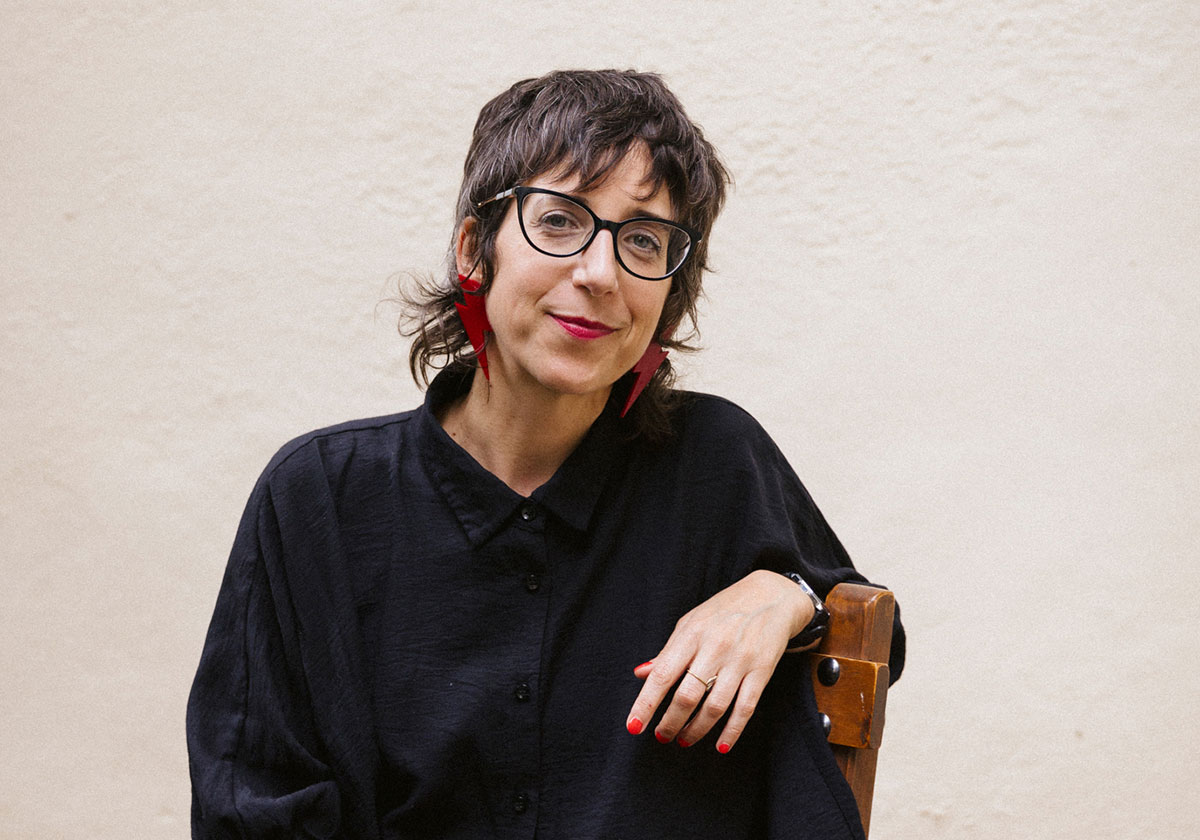
María Ptqk
Born in Bilbao in 1976, Maria Ptqk is a curator, researcher and cultural manager specialising on the intersections between the arts and techno-scientific culture. She holds a PhD in artistic research from the University of the Basque Country, a degree in Law and a degree in Economics, a DEA in International Public Law from Paris II-Sorbonne and Cultural Law from the Uned-Carlos III in Madrid, and a Master in Cultural Management from the University of Barcelona. She has curated the exhibitions Soft Power (Amarika Proiektua Project, 2009), À propos du Chthulucène et ses espèces camarades (Espace virtuel du Jeu de Paume, 2017), Ciencia fricción. Vida entre especies compañeras (CCCB Barcelona, 2021 and Azkuna Zentroa, 2022), Reset Mar Menor. Laboratorio de imaginarios para un paisaje en crisis (CCC El Carme, 2021), Extinción Remota Detectada (LABoral, 2022) and Máquinas de ingenio (Tabakalera, 2023).
She has edited the collective books Breve historia del pimiento para uso de la vida extraterrestre (2017), Especies del Chthuluceno. Panorama de prácticas para un planeta herido (2019) and Laboratorios ciudadanos: una aproximación a Medialab Prado (2021). She is currently curator of Getxophoto, advisor to the Daniel and Nina Carasso Foundation and the publishing house consonni. Since 2024, she has been responsible for the editorial coordination of the academic art, science and design journal .able.